
Drone - Vanguard Rescue

Drone - Vanguard Rescue
Master the skies and conquer the ground in the Drone Hybrid Challenge! First, take to the air—pilot your drone through complex obstacles and specialized farm zones. Once the aerial objectives are secured, the mission shifts to the ground, triggering your pre-programmed land robot to autonomously execute a critical rescue mission. Combining fine motor piloting with strategic automation, the fastest, cleanest land-and-air run takes the prize!
Age Categories
Junior Primary (7 - 9 years old)
High Primary (10 - 12 years old)
Junior Secondary (13 - 15 years old)
High Secondary (16 - 19 years old)
Adult (20+ years old)
Objective
The Drone Hybrid Challenge requires teams to seamlessly combine manual aerial drone piloting with strategic programming. After navigating complex airspace obstacles, the completion of the air mission automatically triggers a ground robot to execute a critical, autonomous land rescue operation, where the fastest and most precise run wins.
Task/Mission
***Attention participants! CIPTRIX can provide rental equipment for Robotics and Drones, however participants will need to bring their own laptops and Internet access.
**For this category, kindly download the following software BEFORE competition day. NO EXTRA TIME will be granted to download the software on the spot.
(Mind+ download WINDOWS): https://download3.dfrobot.com.cn/MindPlus_Win_V1.8.1_RC3.0.exe
(Mind+ download MAC/APPLE): https://download3.dfrobot.com.cn/Mind+_Mac_V1.7.3_RC2.0.dmg
(Sample download): https://drive.google.com/drive/folders/19jq4a8KLCJY84ap2xqp1cWoiHIbQtpFh?usp=sharing
(Map download): https://drive.google.com/drive/folders/1KoVehaNjgSK-bV_tos5kS9EU3tmtfLkt?usp=sharing
(BSR Drone Manual): https://filetourl.org/f/ckFtfPxj
Contestant & Team Specifications
Team Composition: There will be only 1-2 contestants per team competing in the match.
Equipment: Each team can bring up to 1 spare drone and robot. Contestants will not be punished for changing spare drones and robot after each game.
Props: All props in the venue (arena, obstacles, game elements) are provided on-site.
Game Field & Elements
The Arena: A combined field divided into the Flight Corridor (Drone area) and the Ground Rescue Path (Robot area).
Guardian Tower: Located at the end of the Flight Corridor. It has 10 HP represented by LED lights.
Hostages: There are 1-3 Hostages located in the Castle.
Obstacles: The robot will have to navigate through the obstacles without any part of the robot touching the obstacles. For every obstacle that has been knocked/touched by the robot, deduct 5 points.
Map Route: The robot can follow the route on the map to reach its destination, however it is NOT compulsory to do so.
Robot & Drone Requirements
Drone: Drones are quadcopters with 20~23cm inclusive of propeller protectors. The flying weight must not exceed 200 grams (including battery).
The nominal voltage of the power battery must not exceed 4.3V, and the capacity must not exceed 1100mA.
Drones are controlled by programming with AI vision and infrared features to complete the missions.
Robot: 20x 20cm with tolerance of extra 3 cm
It must be programmed to receive a signal/variable from the drone before initiating its movement sequence.
Communication: The drone and robot must communicate via lines of code. The robot must be programmed to "listen" for the drone's signal to begin its run.
Learning Objective/Purpose
- Precision Piloting & Spatial Awareness: Develop fine motor skills and spatial reasoning by manually navigating an aerial drone through complex physical barriers and designated zones.
- Algorithmic Thinking & Automation: Apply strategic programming concepts to design and code an autonomous ground robot capable of executing a precise rescue mission.
- Systems Integration: Successfully link multiple technological domains by engineering a seamless, automated transition between the completion of an air mission and the deployment of a land vehicle.
- Strategic Problem-Solving: Analyze course layouts and mission requirements to optimize the speed, accuracy, and efficiency of the integrated land-and-air run.
- Mission-Oriented Execution: Manage a multi-phase operation under time constraints, demonstrating the ability to seamlessly shift from manual vehicle control to automated system monitoring.
Demo Video
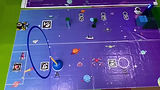
Field Procedures
Time Limit
The entire course (Drone mission + Robot mission) must be completed under 2 minutes (120 seconds).
Start Procedure
Both machines are placed in their respective Start Zones.
The referee gives the signal. The team presses the "Start" button on the Drone.
The Robot must remain stationary and wait for the drone's digital signal. Manually starting the robot is prohibited.
Gameplay Flow
Vanguard Phase: The drone takes off, navigates the obstacles, and shoots the Guardian Tower until all 10 HP lights are extinguished.
Signal Phase: The drone transmits the code. The robot opens Security Gate
Rescue Phase: The robot detects the signal/gate opening, leaves the Start Zone, enters the Hot Zone, collects up to 3 hostages, and returns them to the Safe Haven.
Map Download: https://drive.google.com/file/d/1FuvxRIFHswtE7d0MkWLoleh-W2gRTs8Q/view?usp=sharing
Scoresheet
Mission Objective | Points | Max Points |
Drone: Take-off & Navigation (Successfully clearing the Start Zone) | 20 | 20 |
Drone: Neutralization (10 pts per HP light extinguished on Tower) | 10 | 100 |
Drone: Parking
| X | X |
Hybrid: Synchronization (Robot successfully activates via code signal) | 50 | |
Robot: Breach (Passing through the open Security Gate) | 30 | 30 |
Robot: Hostage Rescue (3 Hostages x 40 pts each) | 40 | 120 |
Robot: Safety Delivery (Returning hostages to the End Zone) (3 Hostages x 40 pts each) | 40 | 120 |
Robot: Parking (Robot stops completely within Safe Haven lines) | 20 | 20 |
Total Time Taken (Max 2 Minutes) | ||
TOTAL | ||
Resets of drone |
|
|
Resets of robot |
|
|
Tie-Breaker: 1. Highest Score 2. Fastest Time 3. Fewest Resets
Disqualifications & Violations
Teams may be disqualified or receive point deductions for the following:
Safety Violation: If the drone flies outside the safety net or endangers spectators/judges.
Prop Damage: Intentionally damaging the Guardian Tower, Security Gate, or Arena mat.
Manual Intervention: Touching the drone or robot during the active round without referee approval.
Communication Interference: Using external network devices (routers, phones) that interfere with the arena's signal protocols.
Rule Zero
Zero Tolerance & Common Sense
In all CIPTR1X competition, Rule ZERO applies, which states:
➤ "If you are not sure whether something is allowed, then it is probably NOT allowed."
All rules are based on common sense, the spirit of the competition, and the safety of all participants.
Any deliberate misinterpretation, violation of the meaning of the rules, or attempt to exploit gray areas for unfair advantage will not be tolerated and may lead to team disqualification from the competition.
Objection
Referee decisions are not subject to teams' objections. In case of disagreements or opposing opinions, the referees have the final say in cooperation with the Headjudges and the Organizing Committee.
In the event that a specific competition category or round is conducted over multiple days or involves multiple attempts, the Organizer reserves the absolute right to determine the most appropriate scoring methodology to identify the winner(s).
Should there be any grievances, participants are directed to: contact@bestemready.com or Whatsapp at 012-391 8681.